Installation & Roofs
Is My Roof Ready for Solar in Florida? The Complete 2026 Readiness Checklist
A Florida roof is ready for solar when it has enough remaining life, documented structural and wind-load capacity, physical soundness, and enough unshaded code-compliant area. Here's the complete 2026 checklist.
Is My Roof Ready for Solar in Florida? The Complete 2026 Readiness Checklist
Quick Answer: A Florida roof is generally ready for solar if it has at least 10–15 years of remaining useful life, can carry the additional 3–5 pounds per square foot of a PV array, and passes a professional inspection for decking, flashing, and wind-load integrity. In Florida's climate, asphalt shingle roofs often become a poor solar host after 15 years. If your roof is approaching that threshold, the financially rational sequence is usually reroof first, solar second. Not sure where you stand? Use our free Roof Readiness Checker to get a personalized assessment.
1. The Non-Negotiable: Remaining Roof Life in Florida's Climate
Solar panels are commonly warranted for 25 years; the roof underneath must be able to outlast the array.
The 10–15 Year Rule
Most Florida solar professionals converge on the same threshold: the roof should have at least 10 to 15 years of useful life remaining before panels go on. For asphalt shingles—the most common Florida roof—intense UV and summer storms typically bring practical life to an end in 15–20 years, not the 25–30 advertised. Many Florida insurers now flag shingle roofs at 15 years and restrict or decline coverage.
Why "Detach and Reset" Is a Real Florida Cost
When a roof fails under an existing solar array, Florida contractors commonly quote $2,000–$5,000 just for the solar removal and reinstallation labor. The first step in the SunRoute workflow is "what is the remaining life of the roof?" — not "how big should the system be?" Start with the Roof Readiness Checker, then use the SunRoute Florida solar savings calculator after the roof decision is documented. If you're still deciding on envelope improvements, the upgrade-priority tool helps you sequence air sealing, insulation, and duct work to right-size the PV system.
2. Structural Load and Wind Readiness: Florida Building Code Requirements
Dead Load
A residential solar array adds 3–5 pounds per square foot. The Florida Building Code requires a licensed engineer to certify structural adequacy. DOE-backed research shows most roofs have more reserve capacity than minimum code values — but that's a reason for verification, not skipping it.
Wind Load: The Florida-Specific Gate
Under FBC Section R324, rooftop PV systems must be designed using ASCE 7, meaning design pressures based on 170 mph Exposure C wind speeds in many jurisdictions. A Florida solar permit package typically needs:
- Wind-load calculations sealed by a Florida PE or architect
- Attachment and flashing details for every penetration
- Module and racking certification meeting required wind rating
- Special inspector affidavit for solar-to-roof-truss connections
The 2026 Florida Building Code, Residential, Ninth Edition sets fire-access setbacks: at least 18-inch clear setback on both sides of a ridge for arrays covering ≤33% of roof area, and 36-inch where the array exceeds 33%.
What to Ask a Structural Reviewer
- The design wind speed and exposure category for your address
- The as-built framing description and whether it was verified visually
- The dead-load and wind-uplift calculations
- The attachment detail for your roof material
- The name and license number of the sealing engineer
3. Roof Material Scorecard: What Works Best for Solar in Florida
Not all roof materials are equal as solar hosts. The differences are about installation risk, penetration count, and lifecycle matching.
Standing-seam metal — Excellent. Clamp-mounted, no penetrations; 40–70 year lifespan; ideal for high-wind zones.
Asphalt shingle — Good, with age caveat. Most common; requires flashed penetrations; practical life 15–20 years in FL heat.
Tile — Good, but sensitive. Long tile life but fragile; underlayment may fail first; higher labor and breakage risk.
Flat membrane (TPO/EPDM/mod-bit) — Good. Ballasted/adhered systems minimize penetrations; check drainage and ponding.
For more on solar and hurricane resilience, see: Solar Panels and Hurricane Season: Protecting Your Investment.
4. The Condition Inspection: What a Solar-Ready Roof Must Pass
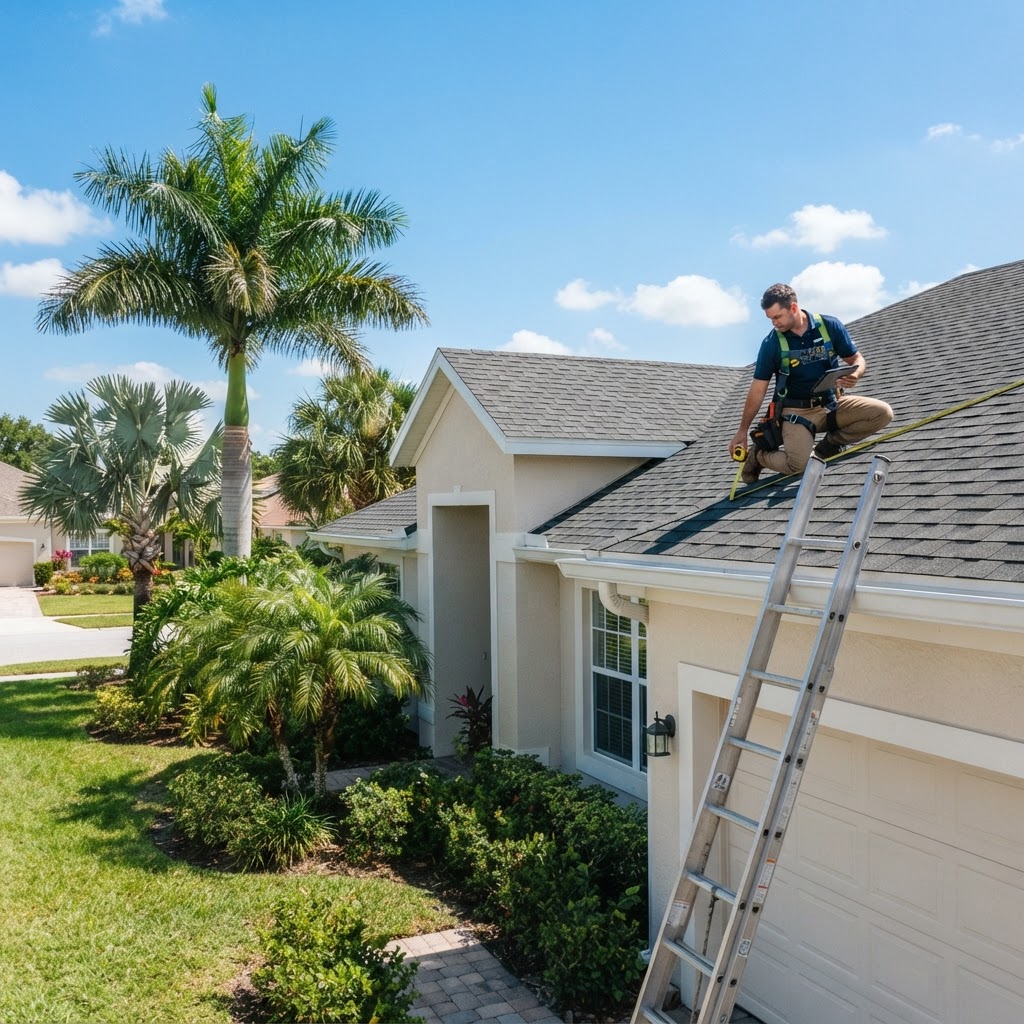
A professional roof assessment for solar should cover:
- Shingle condition: curling, cracking, granule loss, bald spots
- Decking integrity: soft spots, sagging, water intrusion evidence
- Flashing and penetrations: around chimneys, vents, skylights
- Leak history: active leaks, patched areas, stains
- Attic ventilation: adequate intake and exhaust
- Drainage: positive slope, no ponding (flat roofs)
A licensed roofer's written report typically costs $150–$300 and establishes the pre-installation condition. Want to do a first-pass check yourself? Our Roof Readiness Checker walks you through the key questions. If your roof may need replacement, use our Roof Replacement Cost Estimator to budget for it.
5. Shade, Orientation, and Usable Area
Orientation and Tilt
South-facing roofs at 20–30 degrees tilt produce the highest annual output. East/west roofs still work but with lower annual kWh per kW. North-facing roofs are generally poor candidates unless very low pitch.
Shading Is a Derate
NREL's PVWatts applies a shading loss factor, but a proper site assessment uses physical shade analysis or LiDAR. Even small shaded areas disproportionately reduce string production without module-level electronics.
Usable Area After Code Setbacks
The FBC fire-access setbacks reduce usable area. The SunRoute calculator sizes the system from your bill — the roof assessment determines whether that size can be installed.
6. Florida Code, Permits, and Hurricane Hardening
A residential rooftop solar permit typically requires building/electrical permits, engineered structural calculations, module/racking certification, flashing details, fire-access documentation, and an electrical single-line diagram per NEC Article 690.
Some Florida jurisdictions use SolarAPP+, NREL's automated permitting platform, reducing review time by ~12 business days.
Notify your insurer before installation and confirm the array is covered. The 15-year shingle-roof insurance benchmark reinforces the "reroof first" logic. See also: Solar Panels and Hurricane Season: Protecting Your Investment.
7. The Financial Layer: What Changes in 2026
The Federal Residential Credit Is Gone
The federal Section 25D Residential Clean Energy Credit expired December 31, 2025. Homeowner-owned systems placed in service in 2026 do not receive the 30% federal credit. Third-party-owned projects may have a pathway under Section 48E.
What Florida Still Offers
- 100% property-tax exemption on solar added home value, through 2037 (Florida Dept. of Revenue)
- 6% sales-tax exemption on solar equipment
- Full retail-rate net metering for systems 10 kW and under (Florida PSC Rule 25-6.065)
See our Florida Net Metering Guide and Duke Energy Florida Net Metering 2026 Guide.
The 10 kW Threshold
A 10 kW system produces roughly 13,000–14,000 kWh/year in Florida. If your usage requires more, the economics above 10 kW may differ. Reduce load first with the upgrade-priority tool. Learn more: Why Your Florida Home's Insulation Is the Secret to Lower Solar Costs.
Roof Replacement and the Solar Cost Stack
Option A: Replace roof now, then install solar on a new roof with 15–20+ year life.
Option B: Install solar now on an aging roof, then pay $2,000–$5,000 detach-and-reset plus a new roof later.
When the roof is at or beyond the 15-year benchmark, Option A is usually lower total cost. Estimate your replacement cost with the Roof Replacement Cost Estimator, then run the full savings math with the SunRoute calculator with roof replacement included.
For broader context: The Ultimate 2026 Florida Solar Guide and How to Finance Solar Panels in Florida 2026.
8. Decision Framework: Is Your Roof Ready Right Now?
Step 1 — Roof Age and Material
- Metal roof, sound condition: Likely ready
- Tile under 20 years with documented underlayment: Potentially ready
- Asphalt shingle under 10 years: Likely ready if inspection is clean
- Asphalt shingle 10–15 years: Conditional — get a written roof-life assessment
- Asphalt shingle 15+ years: Replace the roof first
Step 2 — Structural and Wind Documentation
- Sealed wind-load and dead-load calculations for your address?
- Physical inspection report (not just satellite)?
- FBC fire-access setbacks identified?
Step 3 — Shade and Orientation
- Shade-free during production hours (9 a.m.–3 p.m.)?
- Predominantly south-facing (or east/west with derate)?
- Usable area supports the system size your usage requires?
Step 4 — Financial Sequence
- Does the 20-year savings estimate work with roof replacement included?
- Confirmed net-metering treatment for your utility? (FPL bill guide, Duke Energy guide)
- Accounted for the loss of the federal credit in 2026?
Use the Roof Readiness Checker to work through Steps 1–3 in a guided format.
Frequently Asked Questions
Can I put solar on a 15-year-old shingle roof in Florida? It's possible but rarely the best financial sequence. Florida shingle roofs often reach end of practical life at 15–20 years, and insurers use 15 years as a benchmark. Fewer than 10–15 years remaining life means replacing first avoids $2,000–$5,000 in detach-and-reset costs.
How much weight do solar panels add? A residential array adds 3–5 pounds per square foot. Most Florida roofs can carry this, but the FBC requires an engineer to certify structural adequacy and wind-load attachments.
What is the fire setback for solar panels in Florida? Under the 2026 FBC Residential, Ninth Edition, arrays covering ≤33% of roof area require an 18-inch setback on both sides of a ridge; arrays covering >33% require 36 inches.
Does net metering still exist in Florida in 2026? Yes. Investor-owned utilities must offer full retail-rate net metering for systems 10 kW and under under Florida PSC Rule 25-6.065. See our Florida Net Metering Guide.
Is the federal solar tax credit still available in 2026? For homeowner-owned systems, no — Section 25D expired December 31, 2025. Florida's property-tax and sales-tax exemptions remain in effect.
Bottom Line: Ready Means Documented
A Florida roof is ready for solar when it has enough remaining life, documented structural and wind-load capacity, physical soundness at the deck and flashing level, and enough unshaded, code-compliant area to host the system your usage requires.
Start with the Roof Readiness Checker to assess your roof's condition. Then use the SunRoute Florida solar savings calculator to see 20-year savings under current Florida rates. If your roof may need replacement, estimate costs with the Roof Replacement Cost Estimator. And if you're in the 10–15 year conditional zone, get the written roof-life report before signing a solar contract.
Ready to find out if your roof qualifies? Request a free Florida solar consultation and a SunRoute advisor will help you assess your roof readiness, utility savings, and next steps — with no pressure and no sales pitch.
Want these numbers for your own home?
Get a free, independent consultation with a solar service provider — no pressure, no obligation.
Request my free consultation